
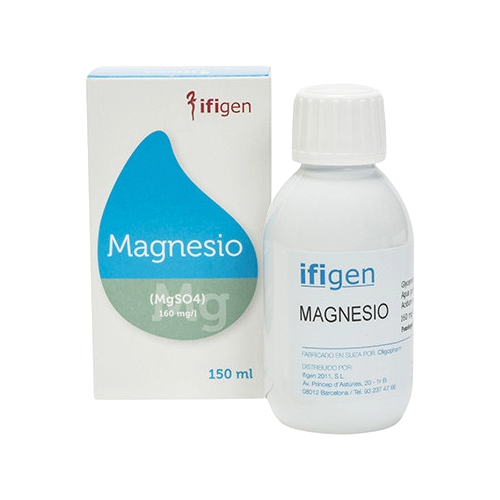
Ifigen Magnesium comes in a glycerin-aqueous formulation. The advantages of the glycerin molecule, which is smaller than that of gluconate, are: improved bioavailability, as it more easily crosses the cell membrane; delayed absorption, resulting in a longer-lasting effect; a masking of the metallic taste of trace elements; and stabilization of trace elements, allowing them to be mixed in equal parts and customized formulas to be created.
The trace elements are ionized for absorption. They are energized with ultrasound. The PET plastic bottles prevent any chelation. Glass is made of minerals, which promote chelation, even in small amounts.
Absorption occurs sublingually. Saliva contains a protein that absorbs trace elements and carries them directly into the bloodstream, facilitating absorption, which in the intestinal tract does not exceed 10%, even when functioning properly. Sublingual absorption releases and reintroduces trace elements stored in the liver and kidneys into circulation.
Magnesium makes up 0.05% of total body weight. Approximately 70% is found in bones, combined with phosphate and bicarbonate. One-fifth of the body's magnesium content is present in soft tissues, bound to proteins. Plasma levels range from 1.4 to 2.4 mg/100 ml. If, for any reason, the body detects that levels are below normal, it reacts by reducing its excretion through the intestines and kidneys. Magnesium is absorbed in the intestines, and dietary elements that compete with its absorption include calcium, phosphorus, oxalate, fiber, and some fatty acids (lipids).